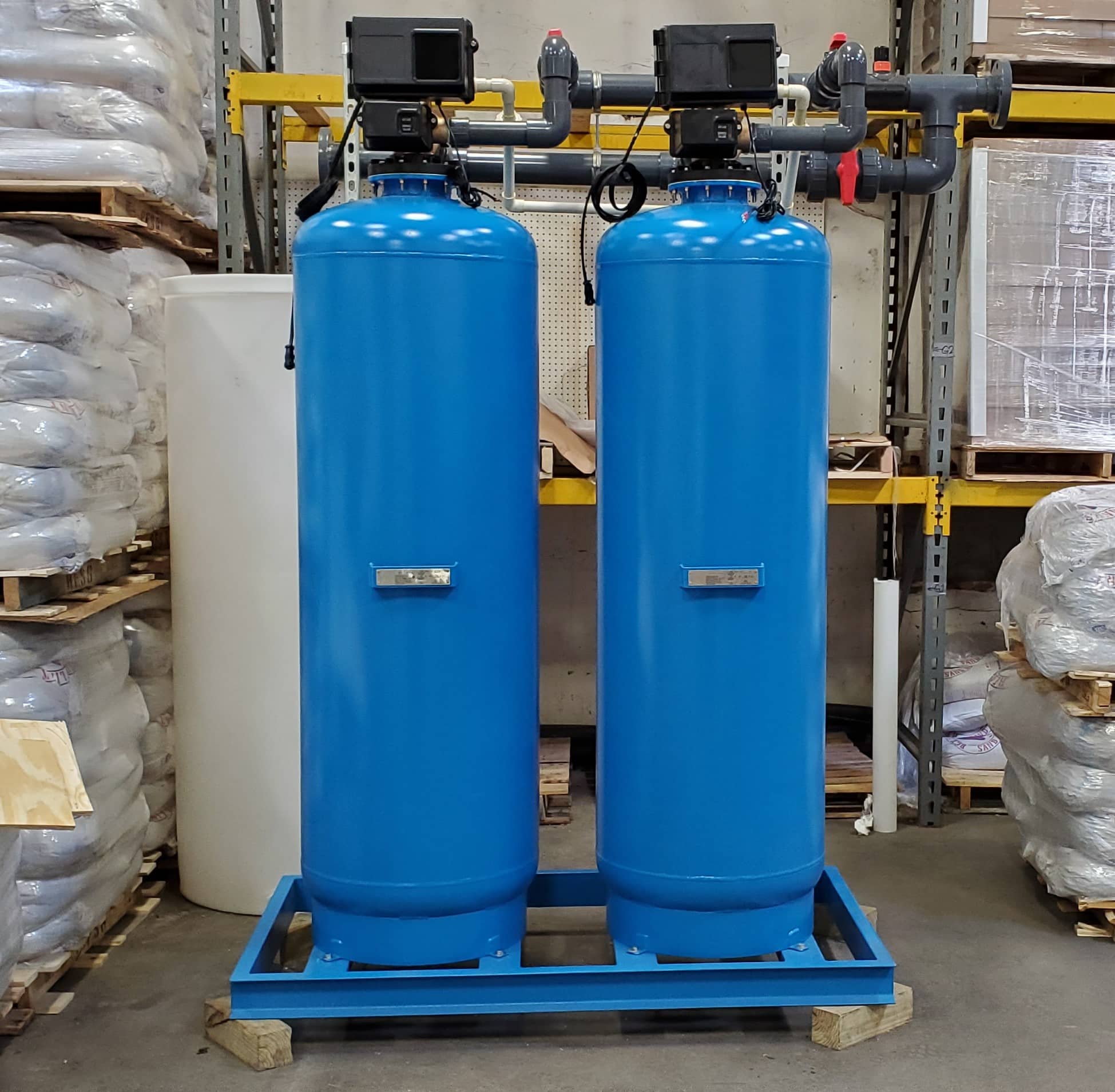
Fleck vs. Clack: Which Water Softener Control Valve is Best?

When selecting a commercial, industrial, or residential water softener control valve, two names dominate the industry: Fleck and Clack. These industry-leading brands are known for their reliability, efficiency, and advanced water softening technology. But each has distinct features, internal mechanics, and programming interfaces that suit different users and applications.
So, which one is the best for your specific water softening needs? Let’s break down the features and benefits of Fleck vs. Clack control valves for water softeners and explore how they differ from one another to help you make an informed decision for your facility or home.
Clack Control Valves: Innovation & Precision
Founded in 1944, Clack Corporation has become synonymous with cutting-edge technology and precision engineering. Their water softener control valves are perfect for facilities that need a highly customizable, energy-efficient solution.
Clack engineers their valves with an added focus on intuitive diagnostics and quiet operation, making them highly desirable for spaces where noise is a concern, like hotels and spas.
Benefits and Features of Clack Valves
Clack valves excel in providing advanced control and salt efficiency, making them an excellent choice for modern setups. Their patented stack assembly design makes them incredibly easy to service, and their programmable options make sure that water softening is tailored perfectly to specific site conditions.
Clack is a popular choice for commercial spaces that prioritize easy programmability, energy efficiency, and seamless multi-tank integration.
- Advanced diagnostic technology: Clack’s innovative digital displays provide real-time data, including current flow rates, peak flow history, and water usage history, allowing for precise control and troubleshooting.
- Exceptional efficiency: Demand-initiated regeneration optimizes water and salt usage, ensuring minimal waste and lower operating costs.
- Quiet operation: The internal mechanics are designed for smooth cycling, making them ideal for environments where noise levels must be kept low.
- Simplified maintenance: Clack valves use a single-piece seal and spacer stack assembly that can be easily removed and serviced without special tools.
Fleck Control Valves: Proven Durability
Manufactured by Pentair, Fleck valves have a legendary history in the water treatment industry. They are globally recognized for their tough, durable construction and high reliability.
Favored for larger, heavy-duty systems, especially in commercial and industrial water softening, Fleck valves rely on a time-tested piston-seal-spacer design that can withstand harsh water conditions.
Benefits and Features of Fleck Valves
Fleck valves are designed for those needing a workhorse system they can count on daily without much hassle. They stand out for their robust performance standards and ability to handle high flow rates and extreme environments.
- Proven durability: Fleck valves are built to last. Many of their commercial models feature lead-free brass valve bodies that hold up amazingly in demanding, high-volume industrial environments.
- Wide range of options: From simple residential systems to enormous multi-tank industrial models (like the 3900 series), Fleck has a highly scalable solution for every need.
- Readily available parts: Because Fleck has been an industry standard for decades, replacement parts, rebuild kits, and servicing guides are widely available anywhere in the world.
- Efficient regeneration: Upgraded SXT and NXT2 digital controllers ensure cost-effective water and salt usage while maintaining excellent softening results across complex commercial networks.
Comparing Clack vs Fleck: The WS1 vs. The 5600 SXT
To get a better look at how these brands compare, let’s break down two of the most popular light-commercial/residential control valves on the market: Clack’s WS1 and the Fleck 5600 SXT. We will compare them by flow rate, capacity, efficiency, ease of installation, and pricing.
Flow Rate & Capacity
| Feature | Clack WS1 | Fleck 5600 SXT |
| Max Flow Rate | 27 GPM | 20 GPM |
| Capacity | 24,000 – 80,000 grains | 24,000 – 80,000 grains |
| Drain Line Flow Control | Adjustable (up to 7 GPM) | Fixed (5 GPM) |
Verdict: The Clack WS1 offers a significantly higher maximum flow rate, which prevents pressure drops in larger households and light commercial applications. However, Fleck still delivers highly reliable performance in a wide range of standard system sizes. (Note: For higher industrial flow rates, both brands offer 1.5-inch, 2-inch, and 3-inch valve sizes. All control valves.)
Regeneration & Efficiency
| Feature | Clack WS1 | Fleck 5600 SXT |
| Regeneration Type | Metered (Demand-Initiated) | Metered (Demand-Initiated) |
| Cycle Time | 80-100 minutes | 90-120 minutes |
| Salt Efficiency | High (Customizable) | High (Customizable) |
| Programmable Cycles | Up to 9 | Up to 5 |
Verdict: Clack has more customizable cycles and a slightly shorter regeneration time, giving it a slight edge in water efficiency and system fine-tuning.
Installation & Maintenance
| Feature | Clack WS1 | Fleck 5600 SXT |
| Installation | Easy (DIY-friendly) | Moderate (may require professional help) |
| Servicing | Tool-free maintenance | Requires basic tools for disassembly |
| Controller Complexity | Simple and intuitive | More complex programming |
Verdict: Clack is generally easier to install and maintain for the end-user due to its tool-free servicing. Fleck is straightforward for professionals but involves a slight learning curve for DIY maintenance.
Pricing & Availability
| Feature | Clack WS1 | Fleck 5600 SXT |
| Starting Price | $959 | $799 |
| Availability | Limited (dealer-only) | Widely available online & in stores |
| Warranty | 5 years (control head), 10 years (resin tank) | 5 years (control head), 10 years (resin tank) |
Verdict: Fleck tends to be more widely available online, often at a lower starting price point. Clack’s strict dealer-only model means professional-grade support and prevents unauthorized, lower-quality distribution, though it comes at a slightly higher premium. Become a dealer.
Why Robert B. Hill Co. Offers Both Fleck and Clack Valves
At Robert B. Hill Co., we understand that there’s no one-size-fits-all solution in water treatment. That’s why we proudly offer both Fleck and Clack control valves: two of the most trusted names in the industry. Each has unique strengths, and we help our customers choose the right valve based on their specific application, infrastructure, and long-term maintenance goals.
When We Recommend Fleck
Fleck control valves are known for their rugged durability, wide availability, and exceptional performance in heavy-duty commercial and industrial systems. Their modular design and extensive product line make them ideal for:
- Facilities with extremely high flow demands: Large factories, hotels, and processing plants.
- Heavy-duty applications: Customers seeking long-term, proven reliability in harsh environments.
- Hot water applications: Fleck offers specific brass valves rated for high-temperature water.
- Easy part sourcing: Systems that require easily accessible, universal replacement parts.
We especially rely on Fleck’s robust brass-body models—like the Fleck 2850, 2900, 3150, and 3900 series—for demanding industrial applications. Their NXT2 networked controllers offer advanced customization for multi-tank operations that need to interlock and communicate to ensure uninterrupted soft water.
Check out these complete lists of our Fleck control valves:
When We Recommend Clack
Clack valves are a fantastic fit for clients who prioritize intelligent diagnostics, energy efficiency, and modern controls. We often recommend Clack when:
- Noise matters: The system is located near retail spaces, office buildings, or residential zones where operational noise must be minimized.
- Precision and programmability are key: Facilities that want to heavily monitor peak flow rates and customize up to 9 stages of regeneration.
- Seamless upgrades: The client already has Clack-based infrastructure and wants to network multiple tanks (alternating or parallel setups).
- Easy maintenance: Facilities whose in-house maintenance teams prefer tool-free, quick-service stack assemblies.
Clack’s WS1.25, WS1.5, and WS2 series are particularly popular in mid-to-large commercial setups thanks to their balance of high flow performance and ease of use.
Final Verdict: Fleck vs Clack
Both Fleck and Clack manufacture high-performing, incredibly dependable water softener control valves. The right choice ultimately comes down to your system’s flow rate requirements, your facility’s environment, and your long-term serviceability preferences.
- Clack valves shine in applications where quiet operation, deep programmability, and ease of maintenance are essential. They are a smart, modern fit for offices, retail spaces, and homes where user-friendly interfaces are a priority.
- Fleck valves are the undisputed workhorses for demanding applications that require a heavy-duty, scalable solution. Their metal bodies, broad product line, and massive availability make them well-suited for industrial facilities, high-flow environments, and retrofits.
At Robert B. Hill Co., we help you assess your unique setup to recommend the absolute best fit, whether that’s a Clack valve, a Fleck valve, or a fully custom-engineered commercial water softening system.
We build water softening systems with the right commercial water filtration systems so your water comes out pure without breaking the bank.
Need help selecting the right valve for your system? Contact us today. We’ll help you build it right the first time.
FAQs About Fleck and Clack Water Softener Control Valves
1. How long do Fleck and Clack control valves typically last?
Both brands are industry leaders in durability. With proper maintenance and occasional seal replacements, both Fleck and Clack valves typically last 15 to 20 years. In highly demanding industrial environments, lifespan depends heavily on water hardness and volume, but their robust designs ensure decades of reliable use.
2. Are Fleck and Clack valves compatible with all types of water softeners?
Yes, both Fleck and Clack control valves are compatible with the majority of standard resin tanks. However, you must match the valve thread size (usually 2.5″ or 4″) and the internal distributor tube diameter to the specific model of your system to ensure optimal flow and performance.
3. What kind of maintenance do Fleck and Clack valves require?
Both are relatively low-maintenance. Routine tasks include checking brine tank salt levels, occasionally cleaning the injector assembly, and ensuring the drain line is clear. Every 5 to 7 years, it is highly recommended to replace the internal seals, spacers, and pistons (in Fleck) or the stack assembly (in Clack) to prevent leaks and bypasses.
4. Can Fleck and Clack valves be repaired or do they need to be replaced?
A major advantage of both brands is that they are highly repairable. Common replacement parts, such as pistons, seals, spacers, injector screens, and circuit boards, are readily available. Rebuilding the internals of these valves is standard practice and extends the life of the valve indefinitely, preventing the need for full system replacements.
5. What factors should I consider when choosing a control valve?
While both feature modern digital controllers, most users find Clack’s interface slightly more intuitive to program due to its advanced diagnostic screens and step-by-step digital menus. Fleck’s SXT controllers are very reliable but may require referring to the manual for specific parameter codes during initial setup.